
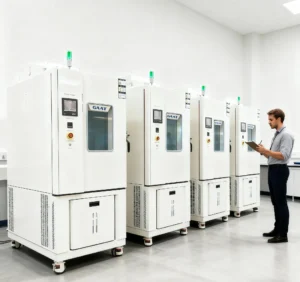
Choosing the right temperature and humidity test chamber is not just a purchasing decision. It is a decision that affects product validation, test consistency, engineering efficiency, and long-term operating cost.
For manufacturers in electronics, automotive components, new energy, materials, packaging, and medical devices, environmental reliability testing is now part of everyday quality and development work. Yet many buyers still face the same problem: many chambers look similar on paper, but perform very differently in actual use.
A good chamber should do more than reach a target temperature or humidity level. It should deliver stable, repeatable results, fit the real sample and workload, support future testing plans, and be easy to operate over the long term.
This guide explains how to choose a temperature and humidity test chamber from a practical, buyer-focused perspective. It is written to help engineers, laboratory managers, and procurement teams make a more informed decision.
1. Start with your testing objective
The first step in selecting a temperature and humidity test chamber is to define what the chamber is expected to do.
Different buyers have very different use cases:
– product development and design verification;
– outgoing quality inspection;
– customer-standard testing;
– third-party or in-house reliability programs;
– future expansion into broader environmental simulation.
If your goal is routine testing for small components, a benchtop temperature and humidity chamber may be sufficient. If your application involves larger samples, batch loading, or full-assembly testing, a walk-in temperature and humidity chamber may be a better fit. If you expect higher-intensity reliability screening in the future, ESS chamber or AGREE chamber solutions may offer more flexibility.
The key is to choose the chamber around the test task, not around a catalog model.
2. Focus on usable range, not just maximum specifications
Many buyers assume that a wider temperature and humidity range automatically means a better machine. In practice, the better choice is the chamber that performs reliably in the range you actually use.
Before comparing models, ask these questions:
1. What temperature range is used most often?
2. Do you need continuous high-humidity exposure, low-humidity control, or cyclic testing?
3. Will the samples generate heat, moisture, or vapor during operation?
4. Are there customer or industry standards that define exact test points?
A reliable temperature and humidity test chamber should not only reach a target value, but also:
– maintain stability at the working setpoint;
– handle ramps and transitions smoothly;
– deliver humidity control that remains practical in real testing;
– perform consistently during long-duration tests.
For most laboratories and manufacturers, stable and repeatable performance matters more than extreme headline numbers.
3. Choose chamber size based on the full testing setup
Sample size is important, but it should never be the only factor when choosing chamber volume.
A proper sizing decision should also consider:
– the number of samples per batch;
– spacing between samples;
– airflow circulation needs;
– fixtures, racks, or sensors;
– powered testing arrangements;
– likely future test expansion.
When a chamber is too small, samples may be loaded too densely, reducing airflow uniformity and affecting test results. This is especially important for assembled electronic products, automotive modules, and other samples that are sensitive to air distribution.
That is why experienced suppliers usually ask not only for sample dimensions, but also for loading method, test duration, and future requirements before recommending a benchtop chamber, standard model, or walk-in climate test chamber.
4. Do not overlook usability and control logic
A chamber may look good in a specification sheet but still be difficult to use every day.
In real laboratory work, buyers should pay attention to practical issues such as:
– whether the interface is clear and intuitive;
– whether test program editing is simple;
– whether alarms are easy to understand;
– whether data display and recording are convenient;
– whether long-term operation is quiet, stable, and energy-efficient.
This is one area where public information from suppliers can be useful. For example, GAAT’s published product information shows coverage across benchtop temperature and humidity chambers, walk-in chambers, AGREE chambers, and ESS chambers. The company also highlights imported LCD interfaces, energy-saving operation, low noise, and stable performance. For buyers, this matters because it indicates attention to operator experience and long-term usability, not just nominal specifications.
5. Match the chamber to the sample type
Not every product should be tested in the same way, even if the target temperature and humidity values appear similar.
Different sample types place different demands on the chamber:
– electronic products may require powered testing and heat-load consideration;
– plastics, coatings, and packaging materials may require better humidity uniformity;
– metal parts and composite materials may involve condensation or multi-stage cycling;
– specialized applications may need cable ports, viewing windows, interlocks, or custom supports.
A supplier that only sends a quotation without discussing sample behavior, standard requirements, or test conditions may not be giving you a fully workable solution.
A more capable environmental test chamber manufacturer will usually ask deeper technical questions before recommending the final chamber configuration.
6. Evaluate the supplier, not only the machine
A good buying decision depends on supplier capability as much as on equipment configuration.
When comparing suppliers, it helps to review three areas.
Product range and scalability
If a manufacturer offers benchtop, standard, walk-in, ESS, and AGREE-type solutions, it usually means the company understands a broader range of applications and can support future testing growth.
Pre-sales consultation
A reliable supplier should help review the sample, utilities, installation site, testing standards, and operating plan before the order is finalized.
According to GAAT’s public company information, its sales and service teams emphasize consultation and after-sales support based on customer requirements. For export-oriented projects and multi-standard testing programs, this kind of support can be just as important as the hardware itself.
Long-term support quality
Late delivery, difficult commissioning, and unstable operation can all slow down product development and increase total cost. Over time, consistency, responsiveness, and support quality often matter more than a small initial price difference.
7. Avoid the low-price trap
One of the most common procurement mistakes is choosing the lowest initial quotation without considering the long-term cost of operation and testing reliability.
A lower upfront price may later lead to:
– unstable or non-repeatable data;
– inefficient loading and test setup;
– higher operating noise or energy use;
– more operator time spent on troubleshooting;
– earlier replacement or secondary purchase.
That is why buyers should think in terms of total cost of ownership, including:
– data reliability;
– equipment durability;
– ease of operation;
– maintenance convenience;
– supplier support;
– future scalability.
8. A practical buying checklist
Before asking for quotations, prepare clear answers to the following questions:
1. What product or material will be tested?
2. What are the size, weight, and loading arrangement of the sample?
3. What temperature and humidity range is used most often?
4. Is the chamber for R&D, quality inspection, or customer-standard testing?
5. Do you need powered testing, cable ports, windows, or data logging?
6. What are the installation requirements for power, water, drainage, and space?
7. Do you expect larger-volume or more advanced testing in the future?
8. Can the supplier provide consultation, commissioning, and after-sales support?
A buyer that prepares these answers in advance is far more likely to choose the right chamber the first time.
9. Frequently asked questions
What is the difference between a temperature and humidity test chamber and a climate test chamber?
In many industries, the two terms are used in a very similar way. A climate test chamber is often a broader term, while a temperature and humidity test chamber more specifically refers to equipment used to control both temperature and humidity for environmental testing.
How do I decide between a benchtop chamber and a walk-in chamber?
A benchtop chamber is usually suitable for smaller samples, lower test volume, and limited laboratory space. A walk-in chamber is more appropriate when the products are large, the batch size is high, or the testing program requires full-size assemblies.
Why is chamber uniformity important?
If temperature and humidity are not distributed evenly inside the chamber, samples in different positions may experience different test conditions. That can reduce the reliability and repeatability of the results.
Conclusion
The right temperature and humidity test chamber should do more than meet a technical specification. It should help your team test more reliably, work more efficiently, and plan with greater confidence.
For that reason, the best buying decision usually comes from balancing application fit, stability, usability, supplier support, and future expansion potential.
If you are comparing options, it is worth prioritizing manufacturers that understand environmental simulation applications, offer a complete product line, and support the buying process from the beginning. Suppliers such as GAAT, with public coverage across benchtop, walk-in, ESS, and AGREE-type solutions and a clear emphasis on consultation, stable performance, and service support, can be a useful reference point when evaluating what a capable partner should look like.
In the end, the best chamber is not simply the one you can buy. It is the one that remains useful, stable, and cost-effective throughout the life of your testing program.